
How it works
Technology
A flotation craft made from engineered fiberglass, launched from a service truck at canal side — quickly deployable, easily serviced, scalable, and modular.
The SAHT produces power by using both the pressure force of water onto the face of the power rotor, while also channeling water behind the rotor — leveraging water's weight and velocity to create deep suction. This suction-augmentation method enables access to a large reservoir of energy that is below the threshold of existing technologies, because it is able to:
Competing technologies also require impoundments, severely limiting their market, their number, and their LCOE.
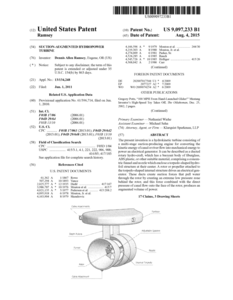
US Patent 9,097,233
The Suction-Augmented Hydropower Turbine was patented in August 2015, and has been described as "brilliantly innovative" by industry leaders. The SAHT is among the new emerging renewables that will be a core technology in the energy mix of the future.
Competitive advantage
A much wider resource base within waterway systems
The SAHT's very low cut-in speed, combined with its shallow profile, gives it access to a much wider resource base than competing technologies — making its LCOE strongly positive, and its potential industrial scale quite large. Arrays of SAHT turbines can be located every 100 yards along suitable canal sections, enabling the successive extraction of water's gravity wave energy as it flows slowly to the sea. Using SAHT turbines, waterway systems can be robotically and autonomously power-farmed for their inertial gravity energy.
Terrestrial hydrokinetics (THK) harvests a small portion of the gravity energy from waterways, similar to wind energy extraction. Turbines have multiple opportunities, at a plethora of locations, to extract reinvested gravity energy from the same water all along its journey — the aggregate power is substantial.
Market outlook
12.5 GW by 2025
Numerous studies by federal agencies and industry groups indicate that the next wave of hydropower development will be in the Pacific Northwest, on canals, rivers, and streams. Both the US Department of Energy and the Electric Power Research Institute predict that by 2025, 12.5 GW of new power will be developed on canal and river systems in North America alone using new hydrokinetic turbines such as the SAHT — worth more than $2.3 billion annually in today's dollars. The DOE further estimates up to 65 GW of additional hydropower can be developed on new stream reaches and rivers in North America.
Because the SAHT is scalable, modular, and launched from a service truck at canal side, it overcomes the major impediments water districts face in generating power within their systems.
The SAHT could catalyze a major shift in the way hydropower production and irrigation modernization programs are funded in canal systems throughout Oregon and the world. I feel confident that water districts everywhere will be very interested in deploying SAHT turbines in their waterways as soon as it is available. Jerry Bryan, SAHT Energy Advisor
Why now
A nexus between water, energy, and population
Water is one of civilization's fundamental deliverables, channeled into canals across most of the planet. The planetary water cycle is also accelerating due to the rise in global temperature, putting more water, faster, into watersheds. As the use of both water and electricity increases with population, generating power from water in transit — largely within canals — is a huge opportunity for hydroelectric development comparable to wind farming.
Generating power from civilization's water while it is in transit to consumers is a large energy prize waiting for the right innovation to capture. Suction-extraction of water's gravity wave represents a transformative approach to efficiently, economically, and sustainably developing this new energy resource — the SAHT provides access to energy that is below the threshold of existing technologies.
See the physics behind suction-augmentation
Read more on the research program, from CFD and FEA studies to the SAHT's role as a grid capacitance service.
Explore the research