
Research & Development
Research
Suction-augmentation is a game-changer for low-head hydropower. Just as water flowing over a weir creates suction, the SAHT's ducted configuration captures side-flow and drives it at super-critical speed across a rotary underwater weir.
It's the equivalent of driving a sonic boom in air. Water has celerity — the point at which the velocity of flowing water overcomes its wave energy and begins to flow at super-critical velocity. The dimensionless number used to describe this phenomenon is the Froude number.
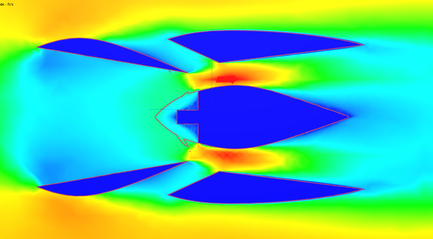
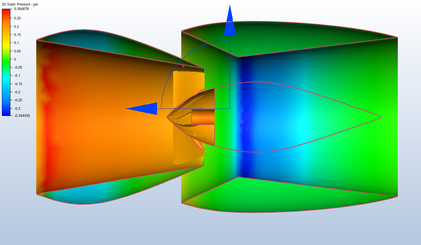
The SAHT is currently undergoing CFD and FEA studies to optimize its functions and obtain maximum power output. It is being engineered to prepare it for prototyping: a sub-scale, fully-functional model will be 3D printed and tested on open water with a full array of sensors and instrumentation.
A grid service, not just power
Capacitance for a renewable-heavy grid
The SAHT turbine incorporates a control system that uses adjustable ducting to provide an essential grid service: capacitance. For the grid to absorb wind and solar energy while maintaining voltage and frequency, a network of natural gas generators must be kept idling and ready to feather the grid's current and voltage.
Because the SAHT can be deployed in networked arrays, it can act in concert across entire waterway systems to instantly adjust output and match grid conditions — compensating for other technologies down-grid. This is a valuable grid service that networked SAHT arrays can provide, reducing the need for standby generators.
Research partners
SAHT Energy's research program is supported by partners including Oak Ridge National Laboratory and the University of Minnesota Duluth.
Meet the advisors